
How to Organize Your Pantry for Effortless Meal Prep
It can take a lot of courage to finally work up the nerve for an all-day pantry re-org. But I am here to sing the praises of having a well-organized pantry when it comes to making meal prep, and time spent in your kitchen overall, a much better experience.
But, first let me admit this: it took me a full two years after moving in to our current home to take up the gauntlet and really dive into organizing our pantry from head to toe.
Today, my goal is to both encourage you and save you numerous headaches by sharing exactly how to go about pantry re-org for maximum meal prep success!
Remember the purpose of your pantry
When you’re trying to motivate yourself to finally get your pantry organized, it’s easy to get caught up in the aesthetics of it all and just focus on how your pantry looks. But this is a losing battle to partake in.
Because, regardless of how your pantry looks (and for that matter, maybe you don’t even have a pantry but just a couple cupboards), it has a job to perform.
Your pantry is for food storage, first and foremost. And we should never lose sight of the fact that function matters more than form when it comes to meal prep.
A helpful re-framing exercise
Even the fanciest five-star restaurants (with big budgets) will focus more on how functional their food storage vs. how beautiful it looks. And this is because, they never lose sight of what their focus is: making great food and doing so efficiently.
So whenever I feel like I’m getting a bit discouraged by how our pantry looks, I try to remind myself that even Michelin star chefs focus more on how well-organized their kitchen and food storage is vs. how pretty it all looks. And that’s because their focus is on the food and making great food efficiently.
Whether you’re starting from scratch or giving your shelves a much-needed refresh, here’s how to properly organize your pantry—and why your future self will thank you at dinnertime.
Why pantry organization matters for meal prep

Let’s face it: meal prep is only as easy as your kitchen allows it to be. Digging through cluttered shelves, expired cans, or half-empty containers slows you down and causes unnecessary stress. When your pantry is clean, labeled, and logically arranged, you gain:
- Quicker meal prep times
- Smarter grocery shopping habits
- Less food waste
- Better portion control
- More space for nutritious staples
- An easier-to-clean kitchen & pantry
With rising food costs and busy schedules, these little wins really add up.
Step 1: take inventory & declutter
Start by pulling everything out of your pantry. Toss expired items, donate what you won’t use, and group what’s left into categories (grains, snacks, baking, canned goods, etc.).
Take the opportunity to wipe down your shelves while they’re bare, if you can!
Step 2: store your most-used food items closest to your cooking area
Spices, sauces, and cooking oils should be near your cooking work station.
You may also want to store a few frequently used canned food items as well. For us, this would be canned tomato sauce, stewed tomatoes, and beans. Convenient meal starters such as boxed pastas, soups, or soup bases are good to keep close as well.
I also like to store a few jars of my favorite bulk goods for easy-access; things like cashews, sesame seeds, sliced almonds, and raisins.
Here’s a real-life snapshot of what I call our “hallway pantry” that is just some stacked cupboards next to our cooking station.

Up high, I like to store our mandolin. Because, although I use it frequently, it is sharp! And that, along with our vitamins and medicine, need to be kept out of reach from little ones.
Here’s a helpful exercise that will help you with your organization efforts:
Think about all of your kitchen cupboards and shelves like real estate. Then, imagine that your cooking and work stations are the beachfront views.

Only give the best, beach front views to food items in your kitchen cupboards and shelves, if they truly need it.
Sugar, flours, salt, and spices are always given priority placement in our kitchen since they are used so frequently. But things like psyllium husk and monk fruit sweetener, I store farther away from the work station, because we rarely use those ingredients.
Step 3: store your less frequently used items in your less convenient cupboards
Logical, right?
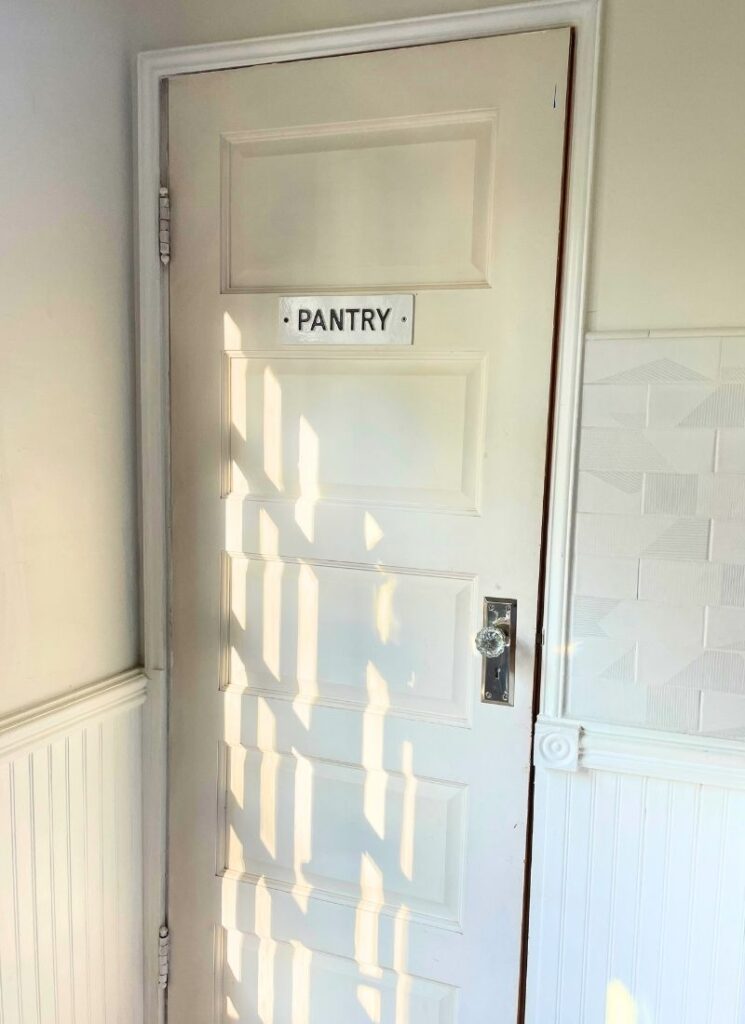
We are luckily enough in our current home to have a walk-in pantry (which you can see below) for this very purpose. Although it’s located at the far end of our kitchen, it’s OK, because we only use it for overflow storage.
While I still frequent this walk-in pantry at least several times a day, it’s no-where near the amount that I am opening up the cupboards next to our stove.
Grouping our food into locations as saved me so much time during meal prep! I hope this helps you as well:

In our walk-in pantry, which you can see above, I store our bulkiest items. Nuts, nut butters, and dried fruits are all stored together.
On the right-hand side I have specialty baking items that I’m not going to use everyday. Those items, such as sugar and flours, are located closer to the my main kitchen work station.
And, lastly, down below, I utilize plastic, pet-food storage containers for our 50 lb bags of flour, corn masa, rice, and dried beans. This is a budget-friendly hack that helps keep our food fresher for longer.
Expiration dates
It’s a good idea to check the expiration dates. Countless times, I thought something was well within its expiration date, only to check and be surprise that it expired a year ago.
But on that note, you can actually eat canned food past its expiration, but the taste and vitamin content may really start to degrade. It’s your call.
Similarly, ground spices from several years ago may still look fine, but their taste and flavor will not be what they should be. Ideally ground spices and blends should be replaced every six or so months. Meanwhile, whole spices can last up to 4 years.
To toss or not to toss?
I follow a similar rule within my food pantry as I do when it comes to my clothing storage: if I haven’t reached for an item in the last 6 months, then it’s on the chopping block. I may still end up keeping that food item if it’s just naturally something that I’m not going to use very often (like Psyllium husk or brewer’s yeast). But if it’s a sauce, soup, or canned food, I seriously consider whether it’s worth the shelf space.
One time, I bought an entire case of mushroom bisque soup only to realize I really don’t like mushroom bisque soup. It took me like three years to finally purge it from the pantry. Don’t be like me, make the call sooner! Your shelves and future meal prepping efforts will thank you.
Step 4: invest in smart food storage containers
A smart food storage container is something that is easy to manage (doesn’t require heavy lifting), that fits on your shelves, and that ideally, is air-tight so your food will stay fresh.
Bonus points if its see-through too so you can tell, at a glance, what food item it’s storing.
I recommend:
- Glass jars of varying sizes with screw-on, air-tight lids
- Clear plastic containers with air-tight snap lids
- Slide-out baskets for snacks or small packets
I’ve had a lot of success with buying varying sizes of mason jars from Azure Standard in bulk. And occasionally, I will see good deals at Goodwill as well for mason jars.
Mason jars are my favorite because you can invest in some plastic, screw-on air-tight lids and they’ll fit everything from a half-gallon mason jar to a 4 oz mason jar. They are so versatile and I think the glass keeps food much fresher than plastic. It’s also a little bit easier to clean since its less porous than plastic.
Step 5: label, label, & label everything

If you have a busy household, everyone needs to be able to find and reference stuff easily. This makes investing in a label maker is a no-brainer for your kitchen and home. And when it comes to enlisting support from others for meal prepping efforts, it’ll make it a more pleasant experience for them to have labeled spices, jars, and bins.
It took me a long time to invest in a label maker. I don’t know why, but it seemed like such a frivolous purchase, and I resisted it for years.
The funny thing is that after making the $30-ish dollar investment on a good-quality label maker, I have saved myself so. much. time. when it comes to finding things in & out of the kitchen.
In most cases, whatever I can do to make meal prepping easier tends to pay me back in dividends.
Step 6: create pantry “zones”
Think of your pantry as a grocery aisle—each shelf or section should serve a purpose:
- Top shelf: rarely used items (holiday serving platters, etc.)
- Eye-level shelf: daily staples (grains, pasta, canned items)
- Lower shelves: heavy items (bulk oils, vinegars, and other large heavy containers)
- Bins & baskets: quick-grab snacks, seasoning packets, bars
- Meal prep zone: ready-to-go ingredients for the week (more on this below)
Step 7: build a meal prep zone
Building a meal prep zone is not something I have personally done, but I plan on having this in place before our second baby arrives this summer.
In particular, I’d like to have some pre-measured protein oat mixes in mason jars that are ready to just add water & go.
The idea, here, is to set aside a section of your pantry specifically for meal prep support. And it might include:
- Pre-measured grains, overnight oat mixes, beans, or other ingredients that need soaking or boiling
- Ready made spice mixtures that you use most often (homemade taco seasoning, anyone?)
- Meal bases (broth cubes and dried vegetable soup bases)
- Labeled bins by day or recipe (e.g., Monday’s bin might have all of your spices, noodles, and other dry ingredients you need for your evening stir-fry)
When it’s time to prep, everything’s in one spot. You can literally grab a bin and get cooking.
Step 8: modify your pantry so it supports your weekly meal plan
Your meal plan and your pantry should be like peanut butter and jelly. If you feel like they’re at odds with each other, then take a step back and consider your shopping habits.
If your pantry is filled to the brim with ingredients you don’t like (and that’s the only reason why they’re still on the shelf), then think about how you can shop differently to ensure your pantry is loaded with food that actually supports your meal prep goals.
What works for me is to have mostly dried food with a few canned food options mixed in. For example, I’ll typically try to use dried beans over canned beans since they’re cheaper and taste better.
But I like to also have the option of dumping something out of a can and moving on with my recipe, when I’m in a rush.
Your pantry should support your lifestyle—not work against it. Use Sunday, or the start of your meal prep week, to:
- Scan your pantry for items that need to be restocked or are nearing expiration
- Plan recipes around what you already have
- Refill your meal prep zone with ingredients for the week ahead
Going one step further with technology
I think it’s safe to say that pantry organization and meal prep will continue to become more integrated with technology. But nothing is going to erase the importance of hard work and everything I outlined in Step 1 – 8.
If, however, you want to go a step further with your pantry organization and meal prepping efforts, you can try integrating your efforts with technology to make life even easier by including:
- Digital food inventory tracking apps
- Smart pantry cameras that let you have a visual of your pantry inventory from your phone
- Voice-activated grocery lists via Alexa or Google Home
- AI-generated meal plans based on what’s in your pantry
In a nutshell:
Prioritizing your pantry’s organization will help you prioritize your meal prep and planning:
The pantry is kind of like the stage that sets the scene for all your meal prepping magic. And a clean, well-stocked, and well-organized pantry, will make all your food prep just a little bit easier.
And this is important, because meal prepping is, by nature, is kind of a messy endeavor. I don’t know about you, but I need all the help I can get in the kitchen.
And I have found all of my extra little efforts to label, organize and think about the function and flow of my pantry have helped me move mountains when it comes time to meal prep and get dinner on the table.
I hope these tips inspire you to pull everything off of the cupboards and shelves and to give your pantry a fresh start, too. It’s time well spent.
Happy meal prepping!